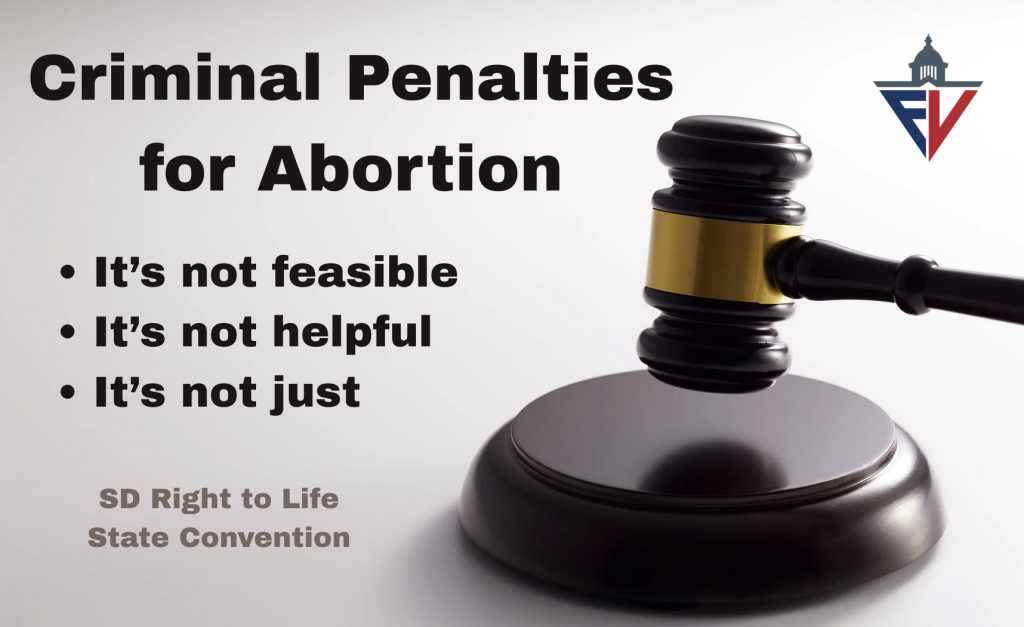

This year legislation has been introduced to apply criminal penalties to a mother who kills her unborn child through abortion. HB1212 – introduced by Representative Tony Randolph and Senator John Carley, has sparked discussion and debate among pro-life friends as they wrestle with the moral, legal, and practical realities surrounding the question of abortion.
SD Family Voice Action will not be supporting this piece of legislation, and have traditionally opposed the application of criminal penalties to the mother for a number of reasons. We are not alone on this decision, but are working alongside allies such as the SD Catholic Conference, Concerned Women for America, SD Right to Life, and a host of national allies.
Continue reading to find:
1 – A summary of the proponent arguments
2 – An examination of principles vs. consequences
3 – Practical questions that must be answered
4 – Moral questions we must weigh
Proponents of HB1212 – The effort to “abolish abortion”
Proponents of the legislation make fairly straightforward moral claims about how our laws should be written. They accurately assert that abortion is murder, and argue that South Dakota law should apply criminal penalties to all murder.
A. Abortion is murder
+
B. Murder is wrong
+
C. The state should punish wrongdoing
therefore
The state should punish, with criminal penalties, everyone involved in an abortion
Proponents assert that “exempting” certain people from penalties is an unequal application of the law. They also assert that if we want to end abortion and show society that abortion is murder, we must apply criminal penalties to the mother for her decision.
Before going any further, a few points of agreement should be underlined. The proponents and the opponents of HB1212 tend to agree on several things:
• We must pursue justice
• We must work to save as many lives as possible
• Our decisions cannot be divorced from the results that come from them
• Many women are deceived by the industry
• Many women are coerced into an abortion
Although starting from these points of agreement, proponents and opponents have vastly different answers to the questions “What should we do next?” and “How do we save as many lives as possible?”
The argument against HB1212
Ideas have consequences – Bad ideas have victims
Decisions of public policy cannot be made in a vacuum. When crafting laws and setting policy, we cannot only ask if the policy seems right, we must also ask what the potential consequences will be. If we make a decision that brings bad results, are we responsible for those results?
The answer: it depends
For example: If a legislator has no real way of knowing their bill would bring bad results, we could argue they are not responsible for those bad results. If however, there was clear evidence or warning of bad results, the person is arguably responsible for them.
The sentiment “Do what’s right, no matter the consequences” does not absolve a person from the fault of making a decision that victimizes others. The “consequences” mentioned in this classic adage are personal consequences: the cost to you, the price you pay, the sacrifice that may be required of you personally. It is a call to courage and sacrifice – not a blanket permission for a person to act as they see fit, no matter the result to others.
Tying this analysis into the pro-life public-policy debate, Chris Maska, J.D. writes:
A law should be judged by whether it achieves its intended purpose. It is, therefore, important to determine what is the purpose of criminal laws against abortion. The principle reason for laws against abortion is that abortion is the killing of an innocent human being. It is wrong to intentionally kill an innocent human being. The purpose of laws against abortion is to stop the killing of innocent human beings. This purpose is only fulfilled if a law actually decreases abortions. A theoretically perfect law against abortion that does not stop abortion has failed to achieve the purpose for which it was enacted. It would be better to have a law that while not theoretically perfect, actually stopped abortions or at least stopped more abortions than a theoretically perfect law. Further, perhaps after the less-than-perfect law has been in effect for some time and the law’s teaching function has changed public perceptions, it might then be possible to enact the theoretically better law and in time it might also be the practically better law.
Mr. Maska underlines the primary question: Does a law actually decrease abortions? We cannot create public policy in a vacuum – it must be crafted and adopted to achieve positive results in our society.
Examining the practical questions at hand
The Abortion Pill Rescue Program
Heartbeat International reported last year that over 7,000 lives have been saved through the abortion pill rescue program. This program is a “last chance rescue” for mothers who have taken the first abortion pill, but want to save the baby.
A practical question that must be answered: If criminal penalties are applied to mothers, will they call a hotline and ask for help after they have made a bad decision? The likely answer: no. It is reasonable to assume that these mothers will not reach out for help, and will not come forward to access the emergency care their babies need.
The complications of the abortion pill
For years, the abortion industry has claimed that taking the abortion pills was safe and that the experience was “similar to a bad period.” They claimed the pills were as safe as taking ibuprofen for a headache. A groundbreaking report in 2025 proved what doctors and pregnancy help center staff members already knew: the abortion pill is dangerous. In fact, the number of women who experience adverse effects from them are 22x higher than the industry had been claiming.
A practical question that needs to be answered: If criminal penalties are applied to mothers who make a bad decision and take the pill, will they seek medical attention in a timely fashion? The likely answer: no.
The Pregnancy Help Centers
Pregnancy help centers have been on the frontlines of the pro-life effort for decades, and have proven to be one of the most effective ways of reaching women in crisis. They open their doors to all, and see incredible fruit from their labor. The stories are endless of mothers and fathers who walk through the door, meet with a caring nurse or counselor, and become committed to raising their child and becoming the parent their child needs.
A practical question that must be answered: If criminal penalties are threatened against a mother who is seeking help, will she be more or less likely to reach out to a pregnancy center for help? The likely answer: dramatically less.
All three of the above scenarios have a common thread: the passage of legislation like HB1212 would reduce or eliminate our chances of reaching a woman in need and saving their baby.
Prosecution of the doctor
One practical reason that criminal penalties were applied to the doctor and not the woman is the need for testimony in court. If penalties are applied to both the woman and the doctor, the doctor has a higher chance of avoiding prosecution. As pointed out in this piece from the society of St. Sebastian, the doctor would have success in threatening the woman into silence by telling her “We are now bound together. If you ever tell anyone about the abortion both you and I could go to jail. Keep this secret.” If mothers know this threat is false, they are more likely to come forward and provide critical testimony necessary to convict the doctor.
Proponents of legislation like HB1212 make a similar claim in the opposite direction. They assert that if we have no penalties to apply, we have no tools to use in making a deal with the mother for her testimony – essentially claiming that she has no reason to come forward or to take action against the doctor. This assertion vastly underestimates the guilt felt by mothers who were deceived or coerced into having an abortion. We hear pro-choice women encouraging each other to “shout your abortion” – but we have seen time and again the passion of post-abortive women who shout the truth because they previously had an abortion.
Public referendum – direct or delayed
Here in America we have the ability to reverse something that our elected officials have done either by referring a new law to a vote, starting a petition drive for an initiated measure (or constitutional amendments) or by electing new leaders who would reverse a decision. When examining the question of criminal penalties for mothers, we must ask ourselves: After the voters have seen examples of young women being thrown in jail because their boyfriend coerced them into having an abortion, would the pro-abortion lobby be more likely or less likely to successfully add abortion into our constitution by initiated amendment? The answer: more likely.
The above realities highlight why a policy change that promotes justice in theory, would bring harmful and unjust results – thus calling into question whether the policy change is actually moral and just. In addition to these factors – which could all be categorized as arguments based on results or consequences – we must also continue examining the moral principles at hand and whether or not this law is just.
Moral questions we must weigh in our pursuit of justice
Punishment for someone under coercion
It is a widely known fact that most mothers who chose abortion made their decision under coercion – they did not freely make their decision. Studies show that coercion and pressure are present 70% of the time. With coercion this present, we must ask – is it just to pursue criminal penalties on a population that is under this level of coercion? Clearly the answer is no.
To learn more about coercion in abortion decisions, click here or here.
Penalty as deterrent
Penalties are often added to provide a deterrent – to serve as a motivator against a person making a certain choice. As mentioned above, most women make an abortion decision under coercion. Deterring someone from making a decision is only possible if they are freely making that decision.
The law is a teacher
While it is true that “politics is downstream of culture” it is also true that when governments enact laws, the laws serve as guides to culture. The law communicates to citizens what is expected vs. what is prohibited, and makes judgements on what is good vs. what is bad. Proponents of legislation like HB1212 point to this fact, and assert that for society to truly become pro-life, we must show citizens (using criminal penalties) that abortion is murder.
“By making something illegal, the legislature is saying something is wrong. However, no sane legislature attempts to criminalize everything that is wrong for a number of reasons” Chris Maska points out in his piece published by Society of St. Sebastian.
The pro-life movement has long united around the need for educating citizens – but with the harms outlined above, criminal penalties are not our best option for advancing the cause of teaching, educating, and inspiring citizens to stand for life.